The Evolution from BPML to BPMN
The evolution from Business Process Modeling Language (BPML) to Business Process Model and Notation (BPMN) marks a significant shift in business process visualization and implementation. BPMN offers a standardized, graphical notation that connects process design with technical execution, providing a vendor-neutral approach for depicting complex business workflows.
Key Takeaways
- BPMN provides a standardized, visual language for documenting and communicating business processes across different organizational levels.
- The notation supports both business user understanding and technical implementation through its comprehensive element categories.
- BPMN 2.0 introduced formal execution semantics, enabling direct model simulation and automation.
- The methodology is implementation-independent, allowing flexible process design without platform constraints.
- BPMN facilitates improved communication between business stakeholders and technical teams, enhancing overall process optimization efforts.
BPMN serves as the industry standard for process modeling, letting you create clear visual representations that everyone in your organization can understand. Its intuitive symbols and consistent structure make complex workflows accessible to both executives and developers. Using BPMN 2.0 specifications ensures your process models follow globally recognized standards.
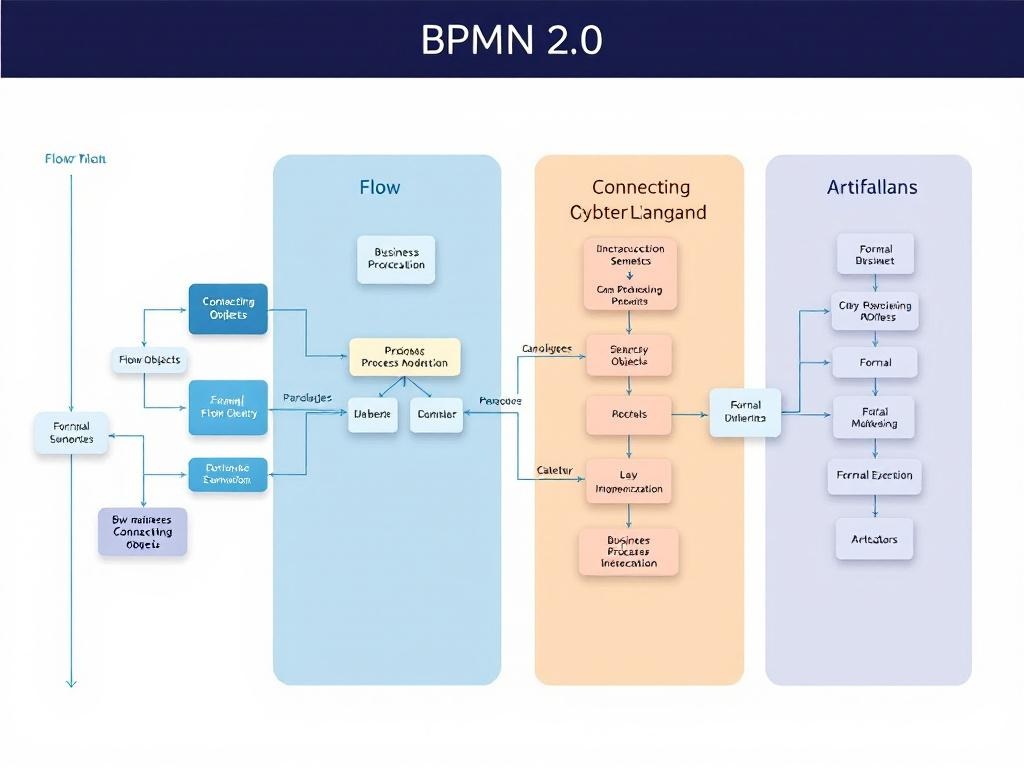
The notation includes four main categories: flow objects, connecting objects, swimlanes, and artifacts. These elements work together to create comprehensive diagrams that capture process flows, decision points, and participant responsibilities. Technical teams appreciate BPMN’s precision, while business stakeholders value its clarity and accessibility.
BPMN 2.0’s execution semantics allow you to move directly from modeling to implementation. This capability eliminates translation errors and speeds up automation projects. Your models can be simulated and tested before deployment, reducing implementation risks and costs.
Platform independence remains one of BPMN’s greatest strengths. You can design processes based on business needs rather than technical limitations, then implement them across different systems and technologies. This flexibility supports digital transformation initiatives and helps future-proof your process architecture.
Organizations that adopt BPMN report improved collaboration between business and IT departments. The shared visual language fosters better understanding and reduces miscommunication during project development. Strategic process improvements become easier to identify and implement when everyone uses the same notation system to discuss workflows.
“Business Process Model and Notation (BPMN) revolutionizes how we visualize and implement workflows by providing a standardized, graphical language that bridges the gap between design and execution. With its vendor-neutral approach and formal execution semantics, BPMN empowers organizations to optimize processes and enhance communication between business and technical teams.”
Business Process Model and Notation (BPMN): The Standard for Process Visualization
BPMN serves as a graphical representation standard that specifies business processes in a flowchart-like visual language. You can use this bpmn methodology to bridge the gap between process design and implementation. As a standardized, vendor-neutral notation maintained by the Object Management Group (OMG), BPMN offers consistency across different platforms and tools.
The evolution from Business Process Modeling Language (BPML) to BPMN marks a significant advancement in process visualization. The Business Process Management Initiative (BPMI) developed the first public specification of BPMN 1.0 in May 2004, synthesizing multiple earlier business modeling notations. While BPML focused on XML-based execution, BPMN emerged as the graphical front-end notation that business users could easily understand. This transition has been crucial for effective process integration across organizations.
Core Elements of BPMN
BPMN consists of four major element categories that help you create comprehensive process models:
- Flow objects: These include events (start, intermediate, end), activities (tasks and subprocesses), and gateways (inclusive, exclusive, parallel)
- Connecting objects: Used for sequence flows, message flows, and associations between elements
- Swimlanes: Pools and lanes representing participants and roles in the process
- Artifacts: Data objects, annotations, and groups that provide additional context
When implementing bpmn standards, these elements work together to create business process diagrams (BPDs) that are both intuitive for business users and precise enough for technical implementation. The standardization has enabled organizations to develop continuous improvement frameworks that can evolve with changing business needs.
BPMN 2.0, released in January 2011, changed the name to “Business Process Model and Notation” to reflect added execution semantics. This version introduced formal execution capabilities and XML schemas, enabling tools to execute or simulate BPMN models directly. You’ll find this particularly valuable when transitioning from process modeling to automation.
The bpmn approach is implementation-independent but includes mappings to execution languages like BPEL. This flexibility allows you to design processes conceptually before deciding on technical implementation details. By maintaining a separation between process design and execution, you can focus on process optimization methods without being constrained by technical limitations.
Businesses that effectively visualize their processes are 7 times more likely to succeed in achieving their strategic goals.
bloomberg.com
The Evolution from BPML to BPMN: Historical Context
The journey from Business Process Modeling Language (BPML) to Business Process Model and Notation (BPMN) marks a significant evolution in how organizations visualize and implement their business processes. Around 2000-2001, the Business Process Management Initiative (BPMI) began discussions about creating a standardized process modeling language that would bridge the gap between business and technical users.
BPML’s evolution began with BPML serving as an XML-based, execution-oriented language focused on the technical implementation of processes. While technically robust, BPML lacked the intuitive visual representation needed for business stakeholders to effectively participate in process design. This limitation drove the development of BPMN as a graphical front-end notation that could complement BPML’s execution capabilities.
The first public specification of BPMN 1.0 was released by BPMI in May 2004, synthesizing concepts from multiple earlier business modeling notations. This standardization effort aimed to create a common visual language that would eliminate confusion and inconsistency in process documentation across different project delivery frameworks.
A pivotal moment came in 2005 when BPMI merged with the Object Management Group (OMG), which subsequently took over BPMN maintenance and development. This merger strengthened BPMN’s position as an industry standard and accelerated its adoption. Under OMG’s stewardship, BPMN continued to evolve, culminating in the release of BPMN 2.0 in January 2011.
From Modeling to Execution
BPMN 2.0 represented a significant advancement, officially changing its name from “Business Process Modeling Notation” to “Business Process Model and Notation” to reflect its expanded capabilities. This version introduced formal execution semantics and XML schemas, enabling direct execution or simulation of BPMN models through compatible tools.
This evolution transformed BPMN from a pure documentation standard to an implementation tool that supports both process mapping in project management and automation. The BPML and BPMN combination effectively created a comprehensive approach to process management that spans from conceptual design through to technical implementation.
Today, BPMN stands as the successor to BPML and numerous proprietary notations, offering a vendor-neutral standard that facilitates communication between business stakeholders and technical teams. Its widespread adoption has created a common visual language for process documentation that transcends organizational and tool boundaries.
Organizations that effectively manage their business processes using BPMN report a 30% reduction in operational costs, showcasing the tangible benefits of standardized process visualization.
forbes.com
Understanding BPMN’s Core Elements and Capabilities
Business Process Model and Notation (BPMN) has revolutionized how you can visualize and implement business processes. The evolution from Business Process Modeling Language (bpml) to BPMN represents a significant advancement in standardizing process modeling across organizations.
BPMN consists of four fundamental element categories that give you complete control over process visualization:
- Flow objects: These include events (start, intermediate, end), activities (tasks and subprocesses), and gateways (inclusive, exclusive, parallel)
- Connecting objects: Sequence flows, message flows, and associations that link your process elements
- Swimlanes: Pools and lanes that represent different participants and roles in your process
- Artifacts: Data objects, annotations, and groups that provide additional context
When implementing project delivery frameworks, these elements help you create clear, executable process maps that bridge the communication gap between business and technical teams.
The Strategic Value of BPMN Implementation
BPMN offers unique advantages that make it superior to earlier bpml bpmn standards. Its implementation-independent nature means you can design processes without committing to specific execution platforms. This flexibility proves invaluable during strategic planning phases.
The notation balances intuitive visualization with precise execution capabilities. While business users can easily understand the flowchart-like diagrams, technical teams can implement the same models directly through BPMN 2.0’s formal execution semantics and XML schemas.
BPMN’s vendor-neutral approach, maintained by the Object Management Group (OMG), ensures you’re not locked into proprietary systems. This standardization makes BPMN particularly valuable for organizations implementing process mapping in project management across different departments or partner organizations.
The bpml bpmn evolution represents a significant shift from purely technical, XML-based process descriptions to intuitive visual models that can still be executed. You can leverage this dual nature to improve communication across your organization while maintaining technical precision in process implementation.
Organizations that use BPMN report a 25% improvement in communication between business users and technical teams, enhancing overall project delivery efficiency.
cio.com