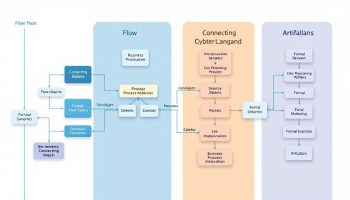

Business process mapping standards like BPMN (Business Process Model and Notation) offer a universal visual language for documenting workflows and procedures across organizations. BPMN serves as the premier framework, enabling consistent documentation through standardized symbols and structures that both technical and business stakeholders can clearly understand.
Understanding the Value of Business Process Mapping Standards
Critical for Organizational Efficiency
Business process mapping standards are vital for companies looking to streamline operations and boost cross-functional collaboration. When you implement BPMN standards, you create a common language that cuts confusion between departments, lowers implementation errors, and enables precise execution specifications that translate directly into automated workflows. This standardization connects business requirements with technical execution, letting you model complex processes with appropriate detail levels for different audiences—from high-level overviews for executives to detailed specifications for implementation teams. BPMN helps you identify inefficiencies, optimize workflows, and maintain consistent quality across operations through a structured approach to process documentation.
The right mapping standards don’t just document processes—they transform how your organization functions. By adopting these standards, you’ll notice improved communication, faster problem resolution, and more effective process improvements.
Using business process mapping standards ensures your team speaks the same visual language when discussing workflows. This common framework reduces misinterpretations and speeds up training for new staff who need to understand your organization’s processes.
10 Essential Business Process Mapping Standards: Enhance Your Workflow Today
In today’s rapidly evolving business environment, effective process management is crucial for success. This section delves into ten essential business process mapping standards you should know to optimize your workflows. From understanding the foundational elements of BPMN (Business Process Model and Notation) to exploring the significance of integrating with related technologies, this list serves as a comprehensive guide for both newcomers and seasoned professionals. Each item highlights key concepts that contribute to clear documentation and efficient execution of business processes.
By adopting these standards, you can foster better collaboration between teams, improve operational clarity, and drive continuous improvement within your organization. Read on to discover how each of these elements enhances your business process mapping strategy.
1. Core Purpose of BPMN (Business Process Model and Notation)
Business process mapping standards like BPMN provide a universal visual language for documenting workflows and procedures. BPMN serves as the gold standard framework that enables consistent documentation across organizations. You can leverage this notation system to create diagrams that both technical and business stakeholders understand clearly. The standardized symbols and structures eliminate confusion when sharing process models with cross-functional teams. By implementing process mapping in project management, you transform complex operations into clear visual representations.
BPMN specifically enables precise execution specifications that can be translated directly into automated workflows. This standardization ensures everyone speaks the same process language, reducing misinterpretations and implementation errors when moving from design to execution.
2. Historical Development and OMG Standardization
The evolution of business process mapping standards represents a fascinating journey of standardization. Before BPMN emerged, organizations struggled with inconsistent flowcharting methods and proprietary notations. The need for standardized business process mapping led to BPMN 1.0’s introduction in 2004 by the Business Process Management Initiative (BPMI).
When the Object Management Group (OMG) merged with BPMI in 2005, they took ownership of maintaining and developing these standards. This merger significantly strengthened BPMN’s position as the leading process modeling notation. The progression from BPMN 1.0 to BPMN 2.0 in 2011 marked a substantial advancement, adding formal execution semantics and expanded notation capabilities.
OMG continues to serve as the governing body that maintains these business process mapping standards through regular refinements. Their stewardship ensures that process mapping methodologies remain relevant as technology and business practices evolve. The standardization provided by BPMN 2.0 has become critical for organizations seeking consistent modeling approaches across departments and systems.
Expert Insight: Understanding the historical development of BPMN highlights the importance of standardization in business process mapping. The merger of BPMI with OMG solidified BPMN’s role as a leading notation, ensuring consistency across organizations. Embrace BPMN 2.0 to enhance collaborative process modeling and stay current with evolving business practices.
3. Flow Objects: Events, Activities, and Gateways in Business Process Mapping Standards
Flow objects form the backbone of business process mapping standards, particularly in BPMN notation. When creating process maps, you need to understand these three essential elements to effectively document workflows.
Events represent specific moments that occur during a business process. In business process mapping standards, events are categorized as:
- Start events (green circles) that trigger process initiation
- Intermediate events (double-bordered circles) that happen during execution
- End events (red circles) that indicate process completion
Activities represent work tasks performed throughout the process. These include:
- Tasks (rounded rectangles) representing atomic units of work
- Sub-processes (rounded rectangles with a plus sign) containing nested activities
- Call activities that reference reusable processes defined elsewhere
Gateways control how process flows diverge and converge. They act as decision points within your process mapping framework, determining which paths to follow based on conditions. Gateway types include:
- Exclusive gateways (diamond with X) for selecting one path
- Parallel gateways (diamond with +) for activating all paths simultaneously
- Inclusive gateways (diamond with circle) for activating one or more paths
Expert Insight: Master the flow objects—events, activities, and gateways—in business process mapping to enhance clarity and efficiency. Clearly distinguish start, intermediate, and end events, define tasks and sub-processes, and strategically utilize gateways to control process flow. This foundational understanding is vital for effective workflow documentation and decision-making.
4. Connecting Objects: Sequence Flows, Message Flows, and Associations
In business process mapping standards, connecting objects serve as the critical linkages between flow elements. Sequence flows represent the order in which activities are performed within your process, shown as solid lines with arrows indicating direction. They establish the path from one activity to the next, ensuring your process follows a logical progression.
Message flows, depicted as dashed lines with open arrowheads, illustrate communication between separate process participants or pools. These are essential when mapping collaboration between departments or external entities in your business processes.
Associations connect artifacts like data objects or text annotations to flow elements. Shown as dotted lines, they provide context by linking supplementary information to your core process elements.
The proper use of these connecting elements in your business process mapping ensures:
- Clear visualization of workflow sequences
- Precise documentation of cross-functional communication
- Proper association of supporting information with process steps
- Enhanced understanding of process dependencies
Expert Insight: To effectively map business processes, clearly differentiate between sequence flows, message flows, and associations. Sequence flows guide the order of activities, while message flows illustrate interdepartmental communication. Associations enhance clarity by linking supplementary information, ensuring a comprehensive understanding of workflow and dependencies.
5. Swimlanes: Pools and Lanes for Organizational Structure
Swimlanes are essential components in business process mapping standards that provide visual organization to your workflows. When documenting complex processes, you need clear boundaries to show who does what. Pools represent entire organizations or participants in a collaboration, creating distinct process boundaries. Each pool contains its own process and can interact with other pools through message flows.
Within pools, lanes divide activities based on specific roles, departments, or systems. This organization helps you visualize:
- Who is responsible for each activity
- Where handoffs occur between departments
- Which systems handle specific process steps
- How work flows across organizational boundaries
Lanes enhance project collaboration by clarifying responsibilities and preventing confusion about task ownership. The vertical or horizontal arrangement of swimlanes provides immediate visual cues about process structure, making it easier to identify bottlenecks where activities cross multiple departments.
When implementing process improvements, swimlanes help you analyze handoff points where delays often occur. By documenting these organizational structures properly, you create process maps that accurately reflect your operational reality and support effective process mapping in project management.
Expert Insight: Utilize swimlanes in process mapping to clearly delineate roles, responsibilities, and interactions within workflows. This visual organization enhances collaboration by pinpointing bottlenecks and handoff points, making it easier to identify inefficiencies. Properly documenting these structures reflects your operational reality and supports effective project management.
6. Artifacts in Business Process Mapping: Data Objects, Groups, and Annotations
Effective business process mapping standards incorporate artifacts that enhance understanding and provide context to process flows. When mapping processes, you need three key artifact types to fully document information requirements and provide clarity:
Data objects are visual representations that show what information is required or produced during process execution. These critical components in business process mapping standards help you track documents, data inputs, and outputs as they move through workflow steps. For example, an insurance claim process map might include data objects representing application forms, verification documents, and approval certificates.
Groups allow you to organize related elements without affecting the underlying process flow. You can use these to:
- Highlight activities requiring special attention
- Cluster steps for analysis or documentation
- Create logical boundaries within your process maps
- Identify areas needing improvement
Text annotations provide additional clarification that might not fit within standard notations. These supplementary notes in process mapping help explain complex decisions, reference policies, or provide context about specific activities. When documenting regulatory compliance processes, annotations can reference specific requirements or explain validation steps.
7. BPMN’s Role in Business-IT Alignment
Business process mapping standards like BPMN play a crucial role in aligning business objectives with IT implementation. BPMN serves as an essential bridge between business requirements and technical execution, allowing both departments to speak the same visual language.
When you implement BPMN in your organization, you create executable process models that can directly drive workflow automation systems. These standardized models reduce ambiguity and minimize translation errors that typically occur when business specifications are converted to technical requirements.
The following elements showcase how BPMN strengthens business-IT alignment:
- Clear visualization of process flows that both business analysts and developers can understand
- Standard notation that eliminates confusion when collaborating on complex projects
- Executable diagrams that can be directly implemented in workflow engines
- Consistent documentation that serves both planning and implementation phases
- Technical precision without sacrificing business-friendly visualization
By adopting these business process mapping standards, you establish a common framework that helps technical teams understand business needs while enabling business teams to appreciate technical constraints.
8. Levels of Process Modeling Detail in BPMN
Understanding the different levels of detail in business process mapping standards allows you to create models that serve various organizational needs. BPMN provides three distinct modeling levels to accommodate different audiences and purposes:
The descriptive level offers high-level process mapping focused on main activities and flows. This level is ideal for business stakeholders who need a clear overview without technical complexity. You’ll find this approach particularly useful when developing strategic planning documents that require executive understanding.
The analytical level delves deeper into process details, including exception handling, data requirements, and performance metrics. At this level, business process mapping standards become more rigorous, enabling process improvement specialists to identify bottlenecks and optimization opportunities. This approach supports comprehensive analysis before implementing changes.
The executable level represents the most detailed modeling approach, containing all technical information needed for automation. This precision allows your process models to be directly implemented in workflow engines. When implementing executable BPMN models, ensure you establish clear project success criteria to measure performance accurately.
The key benefits of these differentiated levels include:
- Appropriate detail for each audience
- Progressive elaboration capability
- Consistency across implementation phases
9. BPMN Extension Mechanisms
When implementing business process mapping standards, you’ll occasionally encounter unique requirements that standard BPMN elements don’t fully address. BPMN extension mechanisms offer a valuable solution by allowing customization while maintaining compatibility with the core standard.
The extension framework within BPMN enables you to create custom elements tailored to industry-specific requirements. For example, healthcare organizations might develop specialized symbols for patient handoffs or regulatory checkpoints that aren’t covered in standard notation. These extensions help process mapping in project management to become more relevant to specialized domains.
Extension attributes provide another flexibility layer, letting you attach additional information to existing BPMN elements without altering their fundamental behavior. Consider these common extension approaches:
- Industry-specific decorators for standard elements
- Custom artifacts representing specialized documentation
- Extended properties for enhanced metadata capture
- Domain-specific connection types
The key challenge lies in balancing standardization with flexibility. While extensions enhance relevance for specific use cases, overusing them can compromise interoperability between different modeling tools and organizations. The most effective approach maintains core BPMN compliance while judiciously adding extensions only where they provide significant value.
10. Integration with Related Standards and Technologies
To fully leverage business process mapping standards, you need to understand how BPMN integrates with complementary frameworks. BPMN works seamlessly with UML (Unified Modeling Language) for system modeling and BPEL (Business Process Execution Language) for process execution, creating a comprehensive approach to process documentation and implementation.
The integration with case management standards like CMMN (Case Management Model and Notation) allows you to handle both structured and unstructured processes in your organization. By connecting BPMN with DMN (Decision Model and Notation), you can separate decision logic from process flows, making your process maps more maintainable.
When implementing steps in business process mapping, consider how BPMN integrates with enterprise architecture frameworks like TOGAF or Zachman. These connections enhance your ability to align processes with organizational objectives and technology landscapes.
Several tools support multiple standards simultaneously, enabling you to create comprehensive process documentation ecosystems while maintaining compliance with business process mapping standards.
Understanding Business Process Mapping Standards
Business process mapping standards, particularly BPMN (Business Process Model and Notation), provide a universal visual language for documenting workflows and organizational procedures with standardized symbols and structures. As the gold standard framework maintained by the Object Management Group (OMG), BPMN enables consistent documentation across organizations while facilitating clear communication between technical and business stakeholders alike.
The Importance of BPMN for Organizations
Business process mapping standards like BPMN are essential for enterprise users seeking to streamline operations, enhance cross-functional collaboration, and implement process automation initiatives. Organizations implementing these standards benefit from:
- Reduced communication gaps between business and IT departments
- Improved process clarity for all stakeholders
- Standardized documentation practices
- The ability to transform process models directly into executable workflows
Ultimately, these benefits lead to more efficient operations and reduced implementation errors.