The Carver Board Governance Model
The Carver Board Governance Model, created by Dr. John Carver in the 1970s, transforms board leadership by focusing on **strategic governance** rather than **day-to-day operations** through a structured set of principles. This approach creates distinct authority boundaries and concentrates on strategic direction, helping organizations achieve more effective leadership.
Key Takeaways
- The Carver model establishes a clear separation between governance and management roles.
- Boards focus on defining organizational outcomes rather than operational details.
- Policy governance provides a systematic framework for strategic leadership.
- The model empowers executive leadership within defined ethical boundaries.
- Accountability increases through regular monitoring and policy benchmarks.
At its core, the Carver Policy Governance model reshapes how boards function. Instead of getting caught up in operational minutiae, boards can concentrate on the bigger picture: setting vision, defining results, and establishing boundaries.
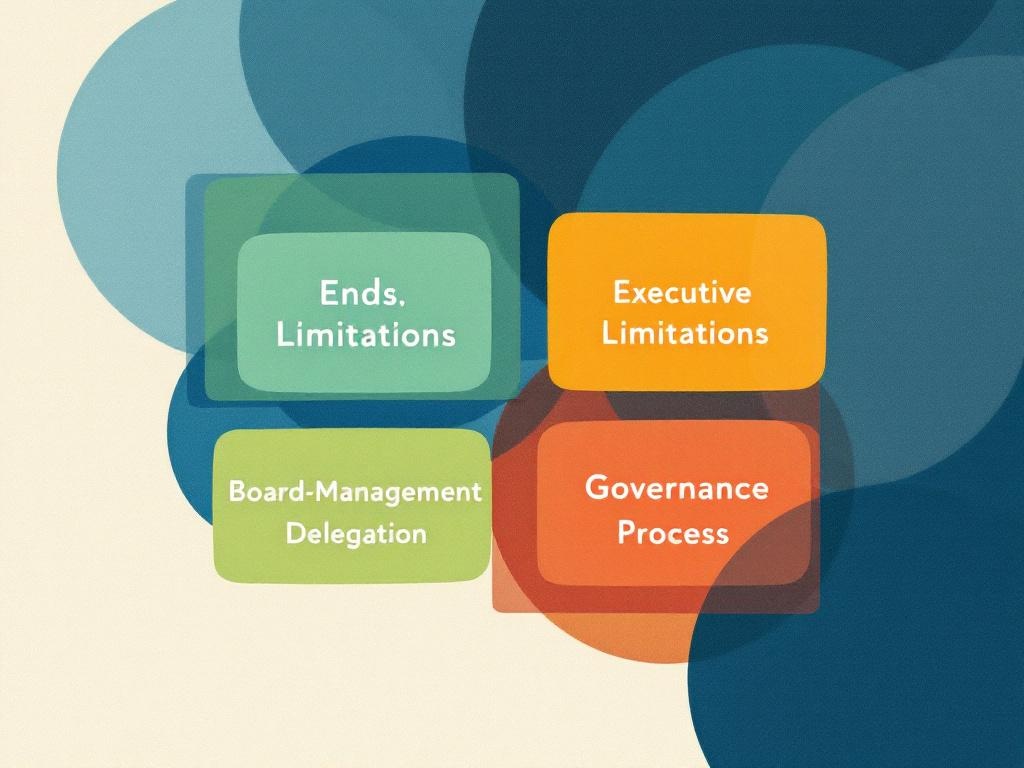
The model works by creating four **policy categories** that guide all board decisions. These categories include:
- Ends policies (what results the organization should achieve)
- Executive Limitations (ethical boundaries for staff)
- Board-Management Delegation (how authority transfers to staff)
- Governance Process (how the board operates)
You’ll find this approach particularly valuable if your board struggles with **micromanagement** or lacks clear direction. By adopting this model, your organization can benefit from improved efficiency, clearer accountability, and better strategic focus.
Many nonprofit and public sector organizations have successfully implemented this governance structure. The model allows CEOs and staff to handle operations confidently while the board maintains appropriate oversight through **regular performance monitoring** against established policies.
For effective implementation, your board should invest time in understanding the model’s principles, developing comprehensive policies, and maintaining discipline in following the established framework. The transition requires commitment but offers significant long-term benefits to your organization’s governance.
When properly executed, the Carver model creates an environment where both policy governance and management can thrive in their respective roles. Board members can focus on representing **stakeholder interests** and setting organizational direction, while executives gain the freedom to apply their expertise within clear boundaries.
Critics note that the model requires significant training and can seem rigid in some contexts. Your organization should carefully assess if this approach aligns with your specific needs and culture before full implementation.
Despite these considerations, the board governance model remains influential because it addresses fundamental challenges in organizational leadership. By clarifying roles and focusing on outcomes, it helps boards fulfill their essential purpose: ensuring the organization serves its mission effectively.
“The Carver Board Governance Model revolutionizes board leadership by defining a clear separation between governance and management, enabling boards to focus on the strategic direction rather than operational minutiae. By empowering executive leadership within ethical boundaries and establishing accountability through systematic frameworks, this model transforms organizational effectiveness and purpose.”
Origins and Principles of the Carver Model
Dr. John Carver developed the Carver Board Governance Model in the 1970s as a comprehensive operating system for boards. This model revolutionizes how boards function by emphasizing strategic leadership rather than operational involvement. The Carver board governance model consists of 10 interconnected principles that must work together to achieve maximum effectiveness.
You’ll find this governance approach addresses traditional weaknesses in board operations, particularly the blurred lines between governance and management roles. The model creates clear authority boundaries with Carver’s core philosophy that “Policy Governance provides clear definition of where governance stops and management starts.”
Key Principles of the Carver Board Governance Model
The foundation of the Carver board governance model rests on several fundamental principles:
- Trust in Trusteeship – Your board represents owners, not themselves or management
- Board Speaks with One Voice – Decisions are collective and binding once made
- Policy Decisions – Your focus stays on high-level direction rather than operational details
- Broad-to-Narrow Policy Formulation – Policies begin with broad statements and narrow only as needed
When implementing the Carver board governance model, you’ll shift from reactive to proactive strategic planning approaches. This transformation enables your board to maintain outward vision while ensuring proper accountability systems.
The model discourages micromanagement by creating boundaries that empower CEO creativity. With the Carver board governance model, your executive team gains freedom to innovate within clearly defined parameters, while the board maintains appropriate strategic oversight without interference.
The Carver board governance model has gained popularity among nonprofits and public sector organizations because it provides a systematic framework for effective governance. By defining what benefits your organization produces, for whom, and at what cost, the model creates alignment between your strategic vision and organizational outcomes.
Your board’s effectiveness increases as you implement the Carver board governance model because it eliminates common dysfunctions like rubber-stamping decisions. Instead, you’ll focus on forward-looking priorities that shape the organization’s future while delegating operational details to your CEO.
Effective governance is not just about compliance, it’s about providing clear direction and creating an environment where innovation can flourish.
hbr.org
The Four Policy Categories Framework
The Carver Board Governance Model establishes clear boundaries through four distinct policy categories that form the backbone of effective governance. You’ll find this framework particularly valuable for creating separation between board and management functions while maintaining strategic oversight. The Carver Board Governance Model provides a systematic approach to policy development that prevents common governance pitfalls.
The four essential policy categories work together as an integrated system:
- Ends Policies – These define what benefits your organization should produce, for whom, and at what acceptable cost. Unlike operational goals, ends policies focus on outcomes and impact rather than activities or methods. With the Carver Board Governance Model, your board can concentrate on determining organizational purpose.
- Executive Limitations – Rather than prescribing how things should be done, these policies establish boundaries of prudence and ethics for CEO decisions. This “if we didn’t say no, it’s pre-approved” approach grants management freedom within defined constraints. The Carver Board Governance Model uses limitations strategically to empower rather than restrict leadership.
- Board-Management Delegation – These policies clarify how your board delegates authority to the CEO and establishes accountability mechanisms. They define reporting relationships, performance monitoring, and evaluation processes. Under the Carver Board Governance Model, the CEO provides written reports with operational definitions and supporting evidence.
- Governance Process – These establish your board’s internal operating procedures, including meeting structures, decision-making protocols, and member recruitment. The Carver Board Governance Model emphasizes that boards must govern themselves before governing organizations.
Monitoring and Accountability Mechanisms
Effective implementation of the Carver Board Governance Model requires robust monitoring systems. Your CEO should provide regular written reports with clear operational definitions and evidence of policy compliance, often validated by third-party sources. This approach enables stakeholder accountability while maintaining role clarity.
The model incorporates quarterly CEO evaluations with numerical weighting of policies. This systematic approach transforms traditional board oversight into a strategic function. By focusing on these policy categories, you’ll create the foundation for a governance system that balances accountability with leadership autonomy.
The Carver Board Governance Model encourages your board to spend less time on operational details and more time on strategic planning and vision development. This shift from micromanagement to macro-governance represents the core value proposition of the model.
Effective governance requires clarity in policy roles; organizations with clear policy frameworks report a 30% increase in accountability and strategic alignment.
hbr.org
Role Clarity and Strategic Leadership
The Carver Board Governance Model creates a distinct boundary between governance and management responsibilities. You’ll find this clarity prevents common board dysfunctions such as rubber-stamping executive decisions or micromanaging daily operations. The Carver Board Governance Model transforms your board from a reactive administrative body into a proactive strategic entity.
When implemented properly, the Carver Board Governance Model empowers your CEO with creative freedom while maintaining appropriate oversight. Your board can establish clear boundaries through Executive Limitation policies that effectively communicate “if we didn’t say no, it’s pre-approved.” This approach frees executives to pursue organizational goals using their expertise without constant board intervention.
Strategic Focus Benefits
The Carver Board Governance Model redirects your board’s attention toward future-oriented strategic decisions rather than administrative details. As John Carver states, “boards should govern with strategic leadership more than administrative detail.” This principle helps your organization in several ways:
- Your board focuses on defining organizational outcomes (Ends Policies)
- Executive leadership handles operational means within ethical boundaries
- Board meetings become more productive with clear strategic agendas
- Directors contribute at a higher level by focusing on long-term vision
- Accountability increases through regular monitoring against policy benchmarks
By implementing the Carver Board Governance Model, you establish effective strategic planning practices that benefit the entire organization. The model encourages boards to concentrate on answering questions about what benefits the organization should produce, for whom, and at what cost.
This clarity also improves project sponsor effectiveness as board members better understand their strategic oversight role versus day-to-day management responsibilities. You’ll notice improved organizational performance when governance and management functions operate in their proper spheres.
The Carver Board Governance Model ultimately transforms how directors approach their responsibilities. Rather than reviewing past decisions or micromanaging staff, your board will develop forward-thinking policies that guide the organization toward its mission while holding executives accountable for results.
Effective governance is about having a clear division of responsibilities and the right balance of strategic oversight.
hbr.org
Implementation Process and Best Practices
Implementing the Carver Board Governance Model requires careful planning and execution to transform your board into a strategic leadership entity. The Carver Board Governance Model empowers boards to shift from reactive oversight to proactive vision-setting when properly implemented.
You’ll need to begin by developing initial policies that capture your board’s core values and priorities. These foundational documents should clearly articulate the organization’s direction while establishing proper boundaries between governance and management roles. Before finalizing these policies, review them against legal requirements and existing organizational frameworks to ensure compliance and identify any gaps.
Structuring your board agendas around monitoring the four policy categories creates intentional focus on what matters most. This practice keeps the Carver Board Governance Model functioning as designed by allocating appropriate time to ends policies, executive limitations, board-management delegation, and governance process issues.
Essential Implementation Steps
The following implementation steps will help your board successfully adopt the Carver Board Governance Model:
- Gather meaningful input from both legal and moral stakeholders to inform policy development
- Adopt a complete policy register through formal board motion (often replacing prior documents)
- Create a comprehensive board calendar specifying when each policy area will be reviewed
- Establish clear metrics for monitoring organizational performance against stated ends
- Develop a training program for new board members on the Carver Board Governance Model
- Implement regular self-assessment of board performance against governance process policies
- Schedule periodic reviews of the entire policy framework to maintain relevance
Your board’s success with the Carver model depends largely on discipline and commitment to the process. Many organizations find that understanding sponsor roles enhances governance effectiveness by clarifying key relationships.
The Carver Board Governance Model works best when your board documents not just its decisions but also the values behind them. This creates an institutional memory that survives individual board member transitions and provides context for future governance choices. Regular policy reviews ensure the framework evolves with your organization’s changing needs and environment.
For optimal results, implement strategic review processes that evaluate both the outcomes achieved and the governance process itself. This dual focus on results and methodology keeps the Carver Board Governance Model functioning as intended – a system that balances appropriate oversight with the freedom for management to execute within defined parameters.
Effective governance is not just about oversight; it’s about empowering boards to lead with clarity and purpose.
hbr.org