Portfolio Prioritization Criteria
Portfolio prioritization criteria create a systematic foundation for strategic decision-making. These criteria allow you to evaluate, score, and rank projects based on essential factors like strategic alignment, value creation, risk assessment, and resource needs. Using effective portfolio prioritization criteria transforms your project selection process, ensuring you allocate limited resources to initiatives that deliver maximum business impact.
Key Takeaways:
- Portfolio prioritization criteria help organizations deliver 40% more value by strategically selecting and ranking projects
- Effective criteria typically include strategic alignment, business value/ROI, cost of delay, resource availability, and risk assessment
- A weighted scoring approach allows customization of prioritization models to reflect unique organizational objectives
- Clear prioritization frameworks enhance decision-making transparency and stakeholder engagement
- Projects aligned with strategic priorities are 57% more likely to succeed compared to non-aligned initiatives
The right prioritization approach can significantly improve your strategy execution success rates. Organizations often struggle with selecting the right mix of projects when faced with competing demands and limited resources.
Effective prioritization criteria act as decision filters, helping you identify which initiatives deserve immediate attention and investment. This process eliminates subjective decision-making and reduces conflicts about resource allocation.
The most successful companies use a structured scoring method that balances strategic importance with practical constraints. By assessing each potential project against consistent criteria, you create a ranked list that reflects your organization’s true priorities.
Your prioritization framework should adapt to changing business conditions. Regular review cycles ensure that your project portfolio remains aligned with current strategic goals and market conditions. This dynamic approach to prioritization allows your organization to remain competitive in rapidly changing environments while maintaining focus on long-term objectives.
“By establishing robust portfolio prioritization criteria, organizations can strategically allocate their limited resources to initiatives that not only align with their core objectives but also significantly enhance value delivery, allowing them to achieve up to 40% more impact. When projects are aligned with strategic priorities, their likelihood of success skyrockets by 57%, underscoring the critical role of effective decision-making frameworks in driving business growth.”
Understanding Portfolio Prioritization: A Strategic Framework
Portfolio prioritization criteria form the backbone of effective decision-making in project management. This systematic process evaluates, scores, and ranks projects based on strategic alignment, value generation, risk profiles, and resource requirements. You’ll find no universal model exists—your criteria should reflect your organization’s unique values and objectives, according to the PMI Standard for Portfolio Management.
The business impact of proper prioritization is substantial. Organizations using robust portfolio prioritization criteria deliver 40% more value than those without structured approaches, according to McKinsey research. Additionally, projects aligned to strategy are 57% more likely to succeed, as reported in the PMI Strategic Alignment Report.
You can approach prioritization through both qualitative methods (multi-criteria scoring with weighted strategic factors) and quantitative techniques (revenue forecasts, NPV calculations). Consider how one FMCG company achieved 20% yearly revenue growth through strategic prioritization of their project portfolio.
Core Portfolio Prioritization Criteria
When establishing effective portfolio prioritization criteria, focus on these key elements:
- Strategic alignment: Measure how well initiatives support your corporate vision and strategic objectives
- Business value/ROI: Calculate expected financial returns and non-financial benefits
- Cost of delay: Assess the value lost by postponing initiatives (time sensitivity factor)
- Resource availability: Evaluate required skills, technology, and capacity constraints
- Risk/complexity: Analyze technical, market, and operational risks thoroughly
- Regulatory requirements: Address compliance needs that may override other priorities
- Customer impact: Consider effects on experience and satisfaction metrics
- Dependencies: Map interconnections between projects affecting sequencing
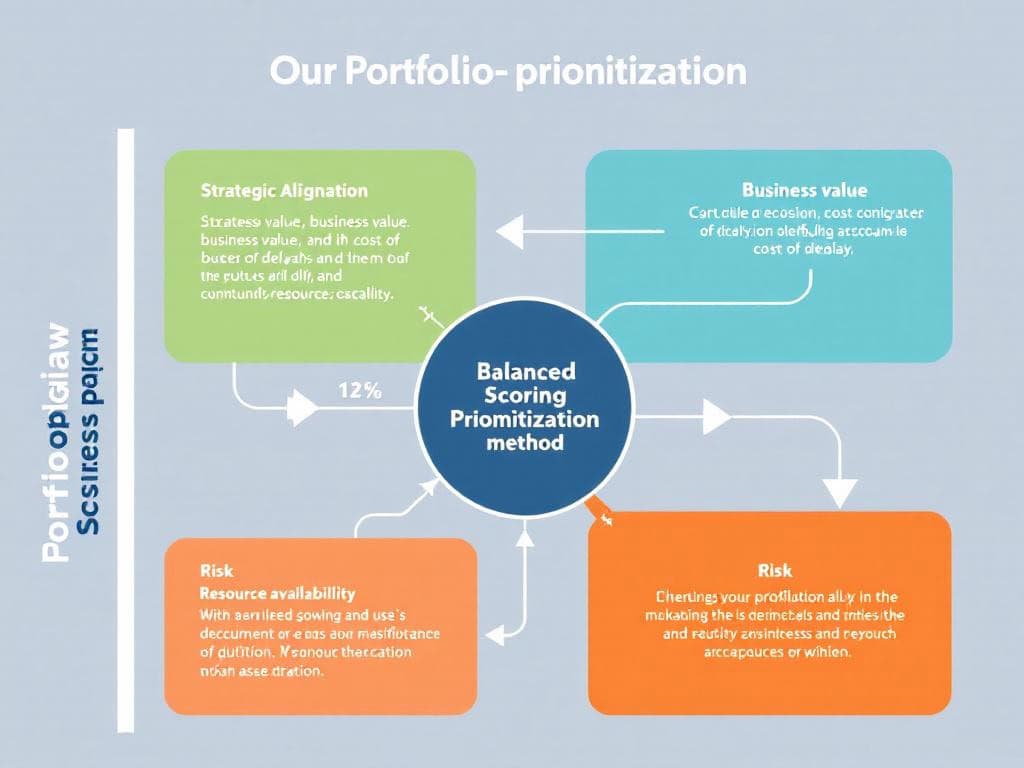
Keep your portfolio prioritization criteria list concise and measurable. A typical weighting example might allocate 40% to strategic alignment, 30% to ROI, 15% to risk assessment, and 15% to resource availability.
The right prioritization model enhances your strategic planning process significantly. Weighted scoring models offer flexibility by assigning customized values to criteria that matter most to your organization. This approach ensures your project portfolio management process remains aligned with organizational goals while maximizing resource utilization.
Implementing clear portfolio prioritization criteria helps avoid common project management mistakes related to resource allocation and strategic misalignment. Your prioritization framework should enable you to make data-driven decisions that balance immediate needs against long-term strategic objectives.
Expert Insight: To effectively prioritize projects within your portfolio, establish clear criteria that align with your organization’s unique values and strategic objectives. Focus on key elements such as strategic alignment, business value, risk assessment, and resource availability, ensuring your criteria are concise and measurable. By implementing a robust prioritization framework, you can enhance decision-making, increase project success rates, and deliver greater value to your organization.
The Business Case for Effective Prioritization
Effective portfolio prioritization criteria forms the backbone of strategic project management. You need systematic approaches to evaluate which initiatives deserve your attention and resources. Without proper prioritization, your organization risks wasting time and money on projects that don’t advance business objectives.
Organizations using portfolio prioritization deliver 40% more value according to McKinsey, while projects aligned to strategy are 57% more likely to succeed as reported by the PMI Strategic Alignment Report. These statistics highlight why establishing robust portfolio prioritization criteria is essential for business success.
Key Benefits of Strategic Prioritization
Strategic alignment ensures your resources focus on initiatives that directly advance organizational goals. When you implement clear portfolio prioritization criteria, you create a framework that connects every project to your strategic vision. This alignment helps you avoid the common trap of pursuing projects that seem valuable but don’t contribute to long-term objectives.
Resource optimization becomes possible when you direct limited assets to your highest-value work. By applying structured portfolio prioritization criteria, you’ll maximize ROI and avoid the costly mistake of spreading resources too thinly across too many initiatives.
Risk management improves significantly with proper prioritization. You’ll identify and mitigate portfolio-level risks proactively by evaluating potential obstacles before committing resources. This effective risk response planning prevents costly surprises during implementation.
Informed decision-making thrives when you establish objective, data-driven portfolio prioritization criteria. This creates transparency around why certain projects advance while others wait or get cancelled. The clarity helps build stakeholder satisfaction and reduces political jockeying for project approval.
Organizations with clear priorities are 16% more likely to be top industry performers according to Booz & Company, while non-prioritizing firms are 10% more likely to be bottom-tier performers. This competitive advantage stems from better efficiency, improved lead generation, and enhanced workforce productivity.
The need for effective portfolio prioritization criteria becomes even more evident when examining real-world examples. An FMCG company targeting 20% yearly revenue growth achieved this ambitious goal by implementing strategic prioritization. Their system evaluated initiatives based on market potential, resource requirements, and alignment with growth targets. By focusing only on the highest-scoring projects, they accelerated their path to success and eliminated wasteful diversions.
Your organization’s strategic planning improves dramatically when portfolio prioritization criteria guides which initiatives move forward and when. This systematic approach ensures you’re investing in initiatives with the greatest potential impact rather than simply responding to the loudest voices or most recent requests.
Organizations using portfolio prioritization deliver 40% more value according to McKinsey, while projects aligned to strategy are 57% more likely to succeed as reported by PMI Strategic Alignment Report.
mckinsey.com
Establishing Effective Prioritization Criteria
Determining the right portfolio prioritization criteria is crucial for making strategic decisions that drive organizational success. Your ability to systematically evaluate and rank projects affects how effectively you allocate resources and achieve business objectives. Organizations using portfolio prioritization deliver 40% more value according to McKinsey, while projects aligned to strategy are 57% more likely to succeed as reported by the PMI Strategic Alignment Report.
You’ll need to balance both qualitative and quantitative approaches when establishing your criteria. Qualitative methods often involve multi-criteria scoring with weights assigned to strategic factors, while quantitative approaches leverage revenue forecasts and NPV calculations to determine financial impact.
Key Prioritization Criteria to Consider
When developing your portfolio prioritization criteria, focus on these essential elements:
- Strategic alignment: Measure how well initiatives support your corporate vision and objectives
- Business value/ROI: Calculate expected financial returns and non-financial benefits
- Cost of delay: Assess value lost by postponing initiatives based on time sensitivity
- Resource availability: Evaluate required skills, technology, and capacity constraints
- Risk/complexity: Analyze technical, market, and operational risk factors
- Regulatory requirements: Address compliance needs that may override other priorities
- Customer impact: Consider effects on customer experience and satisfaction metrics
- Dependencies: Map interconnections between projects that influence sequencing
Keep your portfolio prioritization criteria list concise and measurable. Many successful organizations apply a weighted approach, such as 40% strategic alignment, 30% ROI, 15% risk assessment, and 15% resource availability.
Companies without clear portfolio prioritization criteria are 10% more likely to be bottom-tier performers according to Booz & Company research. Conversely, organizations with well-defined priorities are 16% more likely to be top industry performers. A practical example comes from an FMCG company that achieved 20% yearly revenue growth through strategic prioritization.
Proper implementation of portfolio prioritization criteria enhances your strategic planning process and ensures that resources focus on initiatives that advance organizational goals. This approach also supports better risk management by identifying and mitigating portfolio-level risks proactively.
For maximum effectiveness, your portfolio prioritization criteria should drive transparent decision-making and foster stakeholder engagement. When team members understand how projects are evaluated, they’re more likely to align their efforts with organizational priorities, leading to improved project communication and execution.
Organizations with well-defined prioritization criteria are 16% more likely to be top industry performers.
forbes.com
Selecting the Right Prioritization Models
Choosing the most suitable portfolio prioritization criteria can transform your decision-making process. Organizations implementing effective prioritization deliver 40% more value according to McKinsey, while projects aligned to strategy are 57% more likely to succeed as reported by the PMI Strategic Alignment Report.
Several proven models can help structure your approach to portfolio prioritization criteria:
- Weighted scoring models give you the flexibility to assign values to different criteria with customized weighting based on your organizational priorities. For example, you might allocate 40% to strategic alignment, 30% to ROI, 15% to risk, and 15% to resource availability. This approach brings mathematical rigor to what could otherwise be subjective decisions.
- The value-versus-effort matrix helps you visualize initiatives by plotting them on two axes: potential business value and implementation effort. This simple yet effective tool allows you to quickly identify “quick wins” (high value, low effort) and strategically evaluate resource-intensive projects. When developing your strategic plan, this model helps prioritize initiatives that deliver maximum impact with minimal strain on resources.
- Financial models including NPV (Net Present Value), IRR (Internal Rate of Return), and payback period calculations provide quantitative metrics for comparing investment options. These models are particularly effective when your portfolio prioritization criteria need to emphasize financial returns.
- Risk-based prioritization focuses on identifying and addressing initiatives with significant risk implications first. This approach is crucial when planning risk responses and dealing with regulatory compliance projects.
- Strategic buckets allow you to allocate resources across different categories of work (innovation, maintenance, growth) ensuring balanced investment. This method prevents overinvestment in any single area and helps maintain portfolio diversity.
Implementing Your Portfolio Prioritization Framework
To successfully implement your chosen portfolio prioritization criteria:
- Secure executive sponsorship to ensure organizational alignment
- Develop clear scoring guidelines to maintain consistency
- Create standardized evaluation templates for all potential projects
- Establish a regular review cadence to reassess priorities
- Train decision-makers on using the prioritization framework
- Document decisions and their rationale for future reference
The table below summarizes how different portfolio prioritization models align with various organizational needs:
| Prioritization Model | Best For | Key Portfolio Prioritization Criteria |
|---|---|---|
| Weighted Scoring | Complex decision environments | Multiple criteria with varied importance |
| Value-Effort Matrix | Quick assessment and visualization | Simplicity and immediate insight |
| Financial Models | Investment-heavy portfolios | ROI, NPV, payback period |
| Risk-Based | Regulated industries | Compliance, security, operational risk |
| Strategic Buckets | Balancing innovation and operations | Portfolio diversity and alignment |
Expert Insight: When selecting the right prioritization models for your portfolio, consider aligning them with your organization’s strategic goals and resource constraints to maximize impact. Employ a weighted scoring model for complex decisions, ensuring that critical criteria like strategic alignment and ROI receive appropriate emphasis, or use a value-versus-effort matrix to swiftly identify high-impact, low-effort projects. By leveraging financial and risk-based models, you can also enhance decision-making frameworks that prioritize projects effectively while maintaining a balanced and diverse portfolio.