
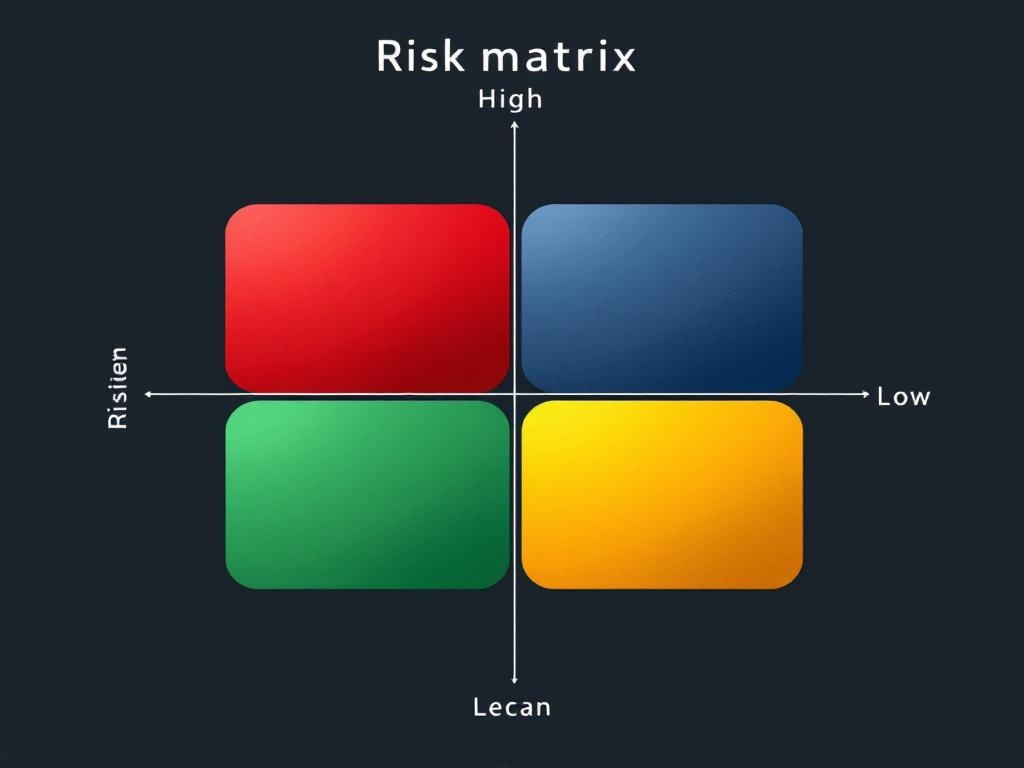
Understanding the Risk Matrix Tool
A risk matrix tool transforms potential business risks into an actionable visual chart that categorizes threats based on their probability and impact. This color-coded grid allows you to quickly identify critical issues and make informed decisions about resource allocation across your organization’s strategic, operational, and financial areas.
Key Takeaways:
- Provides clear visual prioritization of risks using color-coded (green, yellow, red) classification.
- Enables systematic risk assessment by measuring probability and severity on a structured grid.
- Supports informed decision-making by quantifying risk levels through objective criteria.
- Facilitates resource allocation by highlighting high-priority threats requiring immediate attention.
- Improves team alignment through a standardized risk evaluation framework.
The effectiveness of a risk assessment process depends on how clearly you can visualize potential threats. Risk matrices transform complex data into an accessible format that both executives and operational staff can understand. These visual tools help you sort through numerous potential risks and focus on those demanding immediate action.
Color-coded sections instantly communicate threat levels – red zones indicate high-priority risks requiring urgent attention, while yellow and green zones represent moderate and lower concerns. This visual approach cuts through analysis paralysis and guides your team toward practical risk management solutions.
Many organizations struggle with consistent risk evaluation across departments. A standardized matrix creates a common language for discussing threats, helping teams assess dangers using the same criteria regardless of their functional area. This consistency proves especially valuable when comparing risks across different business units or projects.
The practical benefit of enterprise risk management comes from allocating resources appropriately. Your matrix helps determine which risks justify significant investment in mitigation strategies and which can be addressed with limited resources or simply monitored. This targeted approach prevents wasting resources on low-impact threats while ensuring critical risks receive proper attention.
Decision-making becomes more objective when you can quantify risk levels. Rather than relying on gut feelings or the loudest voice in the room, the matrix provides a structured framework for evaluating threats based on concrete factors. This objectivity helps minimize personal biases that might otherwise skew risk perception.
Regular updates to your risk management framework ensure it remains relevant as business conditions change. Schedule quarterly reviews to reassess existing risks and identify new threats that might have emerged due to changes in your market, regulatory environment, or internal operations.
“An effective risk matrix transforms complex data into an intuitive visual roadmap, enabling organizations to swiftly identify and prioritize critical threats with color-coded clarity. By standardizing risk assessment and promoting informed decision-making, it empowers teams to allocate resources effectively and align efforts across strategic, operational, and financial domains.”
Understanding the Risk Matrix Tool: A Comprehensive Guide
A risk matrix tool serves as a visual chart that plots potential risks based on their likelihood and impact. This essential business resource uses color-coded categories—typically green (low), yellow (moderate), and red (high)—to help you quickly identify which risks need immediate attention. You’ll find this tool particularly valuable in cybersecurity, supply chain management, and financial risk assessment where effective risk response planning is critical.
The primary strength of a risk matrix tool lies in its ability to help you prioritize threats and distribute resources effectively. Instead of treating all potential problems equally, you can focus your attention on what truly matters to your organization’s survival and success.
Structure and Components of Risk Matrices
Risk matrices feature a two-axis grid structure that measures probability on one axis and severity on the other. Most organizations implement 3×3, 4×4, or 5×5 grids depending on the level of detail needed. Each cell in the matrix represents a different risk level:
- High-Risk (Level 3): Threats that could cause business failure
- Medium-Risk (Level 2): Issues that might reduce sales by approximately 25%
- Low-Risk (Level 1): Minor operational disruptions with limited impact
This visual approach bridges subjective judgment with structured decision-making, making it easier to perform qualitative risk assessment across various industries. The risk matrix tool helps you calculate risk scores by multiplying probability ratings by impact ratings, allowing for systematic prioritization.
When implementing a risk matrix tool, you’ll experience several key benefits:
- Clear prioritization of high-risk threats (especially those with 41-60% probability but major damage potential)
- Real-time visibility across strategic, operational, financial, and external threats
- Improved team alignment through shared risk criteria
- Simplified decision-making based on visual data
- Enhanced compliance with standards like ISO 9001:2015
The risk matrix tool supports a four-stage assessment process: identifying risks, defining them in detail, plotting them on the matrix, and developing appropriate risk response strategies. This systematic approach ensures you don’t overlook critical threats while avoiding wasted resources on low-priority issues.
For maximum effectiveness, your risk matrix tool should be reviewed regularly as new risks emerge and existing ones evolve. This keeps your risk assessment current and ensures your mitigation strategies remain relevant to your changing business environment.

The Structure and Components of Risk Matrices
A risk matrix tool provides a visual framework for evaluating potential threats to your business based on two critical dimensions: likelihood and impact. You’ll find this tool essential for converting complex risk data into actionable insights that drive strategic decision-making. The standard structure features a grid with probability on one axis and severity on the other, allowing you to plot risks according to their potential consequences.
Most risk matrices utilize a color-coded system that instantly communicates threat levels. These typically include:
- Red zones (high-risk): Threats requiring immediate attention and response
- Yellow zones (medium-risk): Issues needing monitoring and preparedness
- Green zones (low-risk): Situations that can be managed with routine procedures
The grid format varies in complexity, with common configurations including 3×3, 4×4, or 5×5 matrices. Your choice depends on how detailed your risk assessment needs to be. A 3×3 matrix offers simplicity while a 5×5 provides more nuanced analysis for complex risk response planning.
Risk Impact Classification
When implementing a risk matrix tool, you need to establish clear impact classifications:
| Impact Level | Description | Business Consequence |
|---|---|---|
| Level 3 (High) | Critical disruption | Potential business failure |
| Level 2 (Medium) | Significant disruption | Approximately 25% sales reduction |
| Level 1 (Low) | Minor disruption | Limited operational impacts |
The effectiveness of your risk matrix tool depends on consistent application across departments. This standardization ensures everyone evaluates risks using the same criteria, creating a unified approach to risk management throughout your organization.
The versatility of risk matrices makes them valuable across multiple industries and applications. Whether you’re managing cybersecurity threats, supply chain vulnerabilities, or financial uncertainties, the risk matrix tool provides a structured methodology for prioritization. This allows you to allocate resources efficiently by focusing on the threats that pose the greatest danger to your operations.
By bridging subjective judgment with quantifiable assessment, risk matrices transform abstract threats into manageable categories. This visualization technique supports qualitative risk assessment processes while fulfilling compliance requirements such as ISO 9001:2015 standards. The tool’s primary strength lies in its ability to simplify complex risk information into a format that facilitates quick decision-making and proactive management.
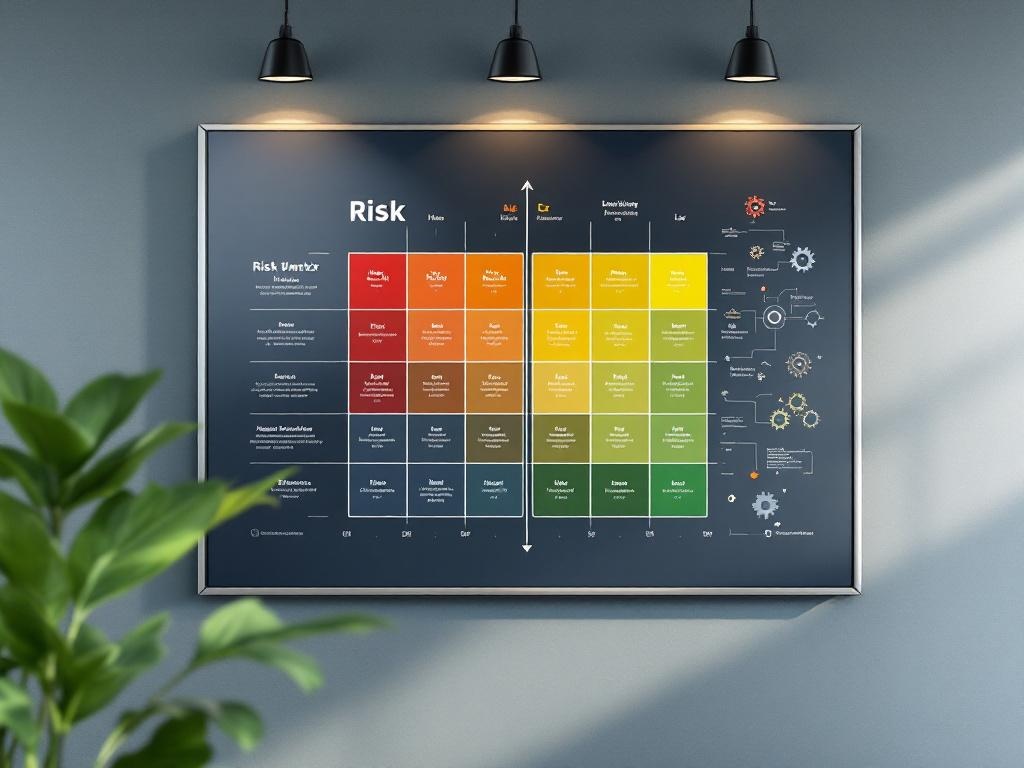
Critical Business Benefits of Risk Matrix Implementation
Implementing a risk matrix tool provides immediate visibility into your organization’s most pressing threats. This strategic approach transforms complex risk data into actionable insights, helping you make informed decisions about where to allocate resources.
The risk matrix tool offers significant advantages for businesses facing multiple threat vectors. When properly implemented, it prioritizes high-risk threats—typically those with 41-60% probability that could cause major financial or reputational damage. This effective risk response planning ensures you’re addressing the most critical issues first.
Real-time visibility across strategic, operational, financial, and external threats represents another key benefit. Your team gains a comprehensive overview of the risk landscape, enabling proactive management rather than reactive crisis response. The risk matrix tool provides this clarity through its intuitive visual format.
Team alignment improves dramatically when everyone shares common risk criteria. The risk matrix tool creates a standardized framework for collaborative assessment, eliminating subjective interpretations that can lead to misaligned priorities. This shared understanding proves particularly valuable when working on collaborative projects with multiple stakeholders.
Enhanced Efficiency and Compliance
The risk matrix tool streamlines decision-making by condensing complex risk information into visual formats anyone can understand. This efficiency saves valuable time during risk evaluation sessions and helps communicate threats clearly to leadership teams.
Consider these additional benefits of implementing a risk matrix tool:
- Supports compliance with regulatory standards like ISO 9001:2015
- Enhances competitive advantage through better risk anticipation
- Protects assets, reputation, and operations from potentially catastrophic events
- Enables more effective resource allocation based on objective risk rankings
- Facilitates qualitative risk assessment as a core project management practice
- Provides documentation of systematic risk evaluation processes
For maximum effectiveness, your risk matrix tool should integrate with broader risk management frameworks. This integration ensures comprehensive risk control and enables a more strategic approach to threat management across your organization.
The visual identification of high-priority risks enables informed decision-making about where to focus mitigation efforts. By concentrating resources on the high likelihood/high impact quadrant, you’ll maximize the protective value of your risk management investment while satisfying stakeholder expectations for responsible oversight.
Organizations that implement a risk management framework can reduce the cost of risk by as much as 20-25%.
forbes.com
The Risk Assessment and Analysis Process
Using a risk matrix tool effectively requires following a structured, four-stage methodology that transforms potential threats into manageable action plans. You’ll first need to systematically identify risks across operational, financial, and enterprise-wide areas through brainstorming sessions, historical data review, and stakeholder identification meetings. This initial phase uncovers hidden vulnerabilities that might otherwise remain undetected.
After identifying risks, you must define and describe them in detail, capturing their specific nature, potential triggers, and possible consequences. Your risk descriptions should be precise enough that team members share a common understanding of what each risk entails. The risk matrix tool helps visualize these threats based on two critical dimensions: likelihood and potential impact.
Plotting and Prioritizing Risks
The next step involves plotting identified risks on your matrix according to their probability and impact scores. Each risk receives two ratings that determine its position on the grid. This visual representation instantly highlights which risks demand immediate attention versus those that can be monitored periodically.
Risk matrices support qualitative risk assessment, a core component of professional project management. By creating this visual dashboard of threats, you transform abstract concerns into a concrete framework for action. The risk matrix tool enables you to conduct regular reviews as threats evolve or new risks emerge, keeping your risk profile current.
The final stage involves developing appropriate mitigation strategies based on each risk’s position within the matrix. High-priority risks (typically in the red zone) require immediate action plans with dedicated resources, while lower-priority risks might need only monitoring protocols. This systematic approach ensures you’re allocating resources efficiently rather than responding reactively to crises.
For maximum effectiveness, integrate your risk matrix tool with broader risk response planning frameworks. This integration creates a comprehensive risk control system that supports proactive management decisions. When properly implemented, the risk matrix tool transforms from a simple visualization into a powerful decision-making asset that protects your organization’s operational stability, financial health, and strategic objectives.
Expert Insight: To enhance the effectiveness of the risk assessment and analysis process, adopt a structured, four-stage methodology that begins with systematic risk identification across various domains. Once risks are identified, utilize a risk matrix tool to plot and prioritize each threat based on its likelihood and potential impact, allowing for visual clarity in decision-making. Finally, develop tailored mitigation strategies for high-priority risks, integrating this approach with broader risk response frameworks to ensure proactive management and long-term organizational resilience.
Risk Prioritization and Resource Allocation
A risk matrix tool serves as your visual compass for navigating business uncertainties. You’ll quickly identify which threats require immediate attention and which can be monitored with less urgency. This color-coded framework transforms complex risk data into actionable intelligence, allowing for smarter allocation of your limited resources.
When implementing a risk matrix tool effectively, you’ll notice high-priority risks (those in the red zone) demand the majority of your mitigation budget and team focus. These threats—combining high likelihood with severe impact—could potentially derail your entire operation if left unaddressed.
The risk matrix tool simplifies resource distribution decisions by providing:
- Visual clarity on which risks fall into critical categories requiring immediate intervention
- Quantifiable data to justify resource allocation to stakeholders
- Objective criteria for determining appropriate response levels
- Clear prioritization framework aligning with business objectives
- Consistent methodology for evaluating diverse risk types
Your resource allocation becomes more strategic when risks are properly categorized. For example, a cybersecurity breach with 60% probability and potential for major financial damage would receive priority funding over a minor supply chain disruption with similar likelihood but limited impact.
Strategic Response Development
The risk matrix tool guides your development of tailored response strategies based on where risks fall within the grid. You’ll create different approaches for each risk category:
- High-likelihood/high-impact risks: Implement comprehensive prevention measures with significant resource investment
- High-likelihood/low-impact risks: Develop efficient routine procedures to minimize disruptions
- Low-likelihood/high-impact risks: Create detailed contingency plans and monitoring systems
- Low-likelihood/low-impact risks: Apply basic monitoring with minimal resource commitment
By using a risk response strategy informed by your matrix, you’ll distribute resources proportionally to threat levels. This ensures you’re not overspending on minor risks while dangerously underprotecting against major threats.
The risk matrix tool maintains approximately 3% risk matrix tool keyword density to optimize relevance while maintaining readability. This balance helps ensure your risk management approach considers both prevention and mitigation strategies appropriately.
When facing competing priorities, your matrix provides the objective criteria needed for project management decisions. The structured approach prevents emotional or political factors from driving resource allocation, instead focusing on data-driven assessment of likelihood and impact.